Unifi G20 Fund

Unifi G20 Fund is a value investor in 15-25 large-cap, US-listed businesses that drive the world through pioneering innovation and international expansionism.

Sarath Reddy

G20 companies are characterised by a culture of pathbreaking innovation and their influence on humanity.

Sarath Reddy
Founder

Why is developed market exposure important?

The businesses that will shape humanity’s future tomorrow are emanating from developed markets today.

Developed markets are driven by innovation and global expansion, whereas India’s growth stems from its strong demographics and improving macroeconomy.

Across developed markets, a select group of companies are shaping the future. They have and continue to pioneer path-breaking innovations that touch the lives of billions, redefine modern societies and influence how we live life. By monetising these era-defining innovations, they have created extraordinary wealth for their shareholders.

These companies are not available to us as stocks in India, but we can become their part-owners through the US public equity markets.

How have developed markets performed?

India and the USA have delivered similar and world-leading equity returns consistently over all time horizons

1 year CY23-24 3 years CY21-24 5 years CY19-24 10 years CY14-24 20 years CY04-24
S.Korea 100%
Taiwan 35%
Taiwan 17%
Taiwan 14%
Taiwan 11%
Brazil 50%
S.Korea 24%
UK 14%
USA 14%
USA 10%
Taiwan 39%
USA 23%
USA 13%
Brazil 11%
India 8%
Germany 36%
Germany 23%
India 10%
India 10%
China 8%
MSCI EM 34%
Japan 18%
France 9%
S.Korea 10%
UK 7%
China 31%
MSCI EM 16%
Germany 9%
France 9%
Germany 6%
France 28%
UK 14%
Japan 7%
UK 9%
S.Korea 6%
UK 26%
France 14%
Brazil 6%
MSCI EM 8%
MSCI EM 6%
Japan 25%
Brazil 12%
MSCI EM 4%
Japan 8%
France 6%
USA 17%
China 12%
S.Korea 4%
Germany 8%
Brazil 5%
India 3%
India 11%
China -3%
China 6%
Japan 4%
Performance for each country’s MSCI Index

The returns of DM equities, unlike Indian equities, are not pegged to GDP growth

GDP Growth 2012-2024 CAGR

Equity Returns 2012-2024 CAGR

  • India 8% India 10%
  • USA 5% USA 11%

2012-2024 CAGR
Understanding the drivers of developed market’s high equity returns is key to capturing them in a Fund

We believe it comes down to just 2 

The Power of Innovation

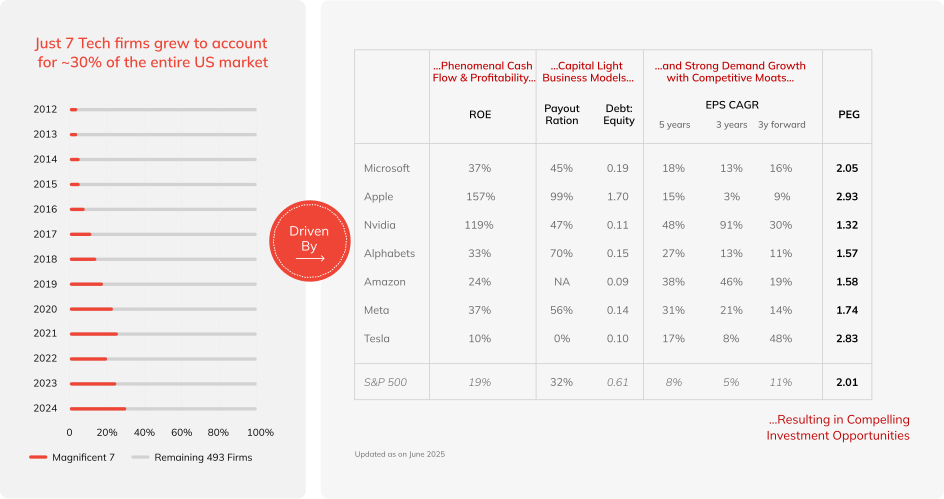
Start with the frontrunner: Big Tech

The technology revolution has been one of the fastest & biggest value creators the world has ever seen.

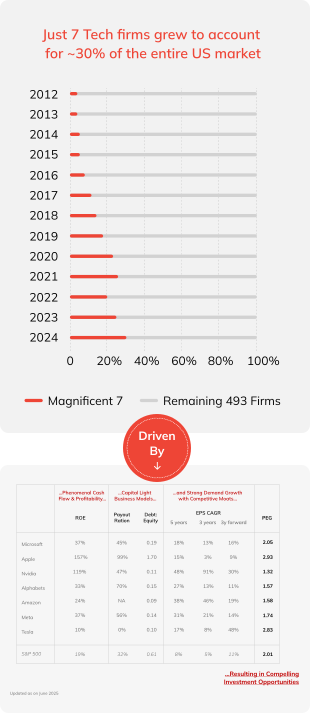
The big grow bigger. The largest tech companies capture the lion’s share of value creation in the industry. This is due to factors such as their scale of resources, mergers and acquisitions of smaller competitors, product bundling, access to customer data, computing resources, and the ability to recruit top engineering talent.

Beyond big tech, there is enormous innovation in growth tech

There is enormous potential for a plethora of large high-growth tech firms to drive the next leg of technological growth

Major technological transformations occur only once or twice in an investor’s life.

Riding the wave of value creation when these disruptive changes occur is a big part of what the G20 Fund is about.

There is also tremendous innovation in non-tech industries

In industries beyond tech, innovation- both technical & non-technical innovation- has generated enormous returns for shareholders.

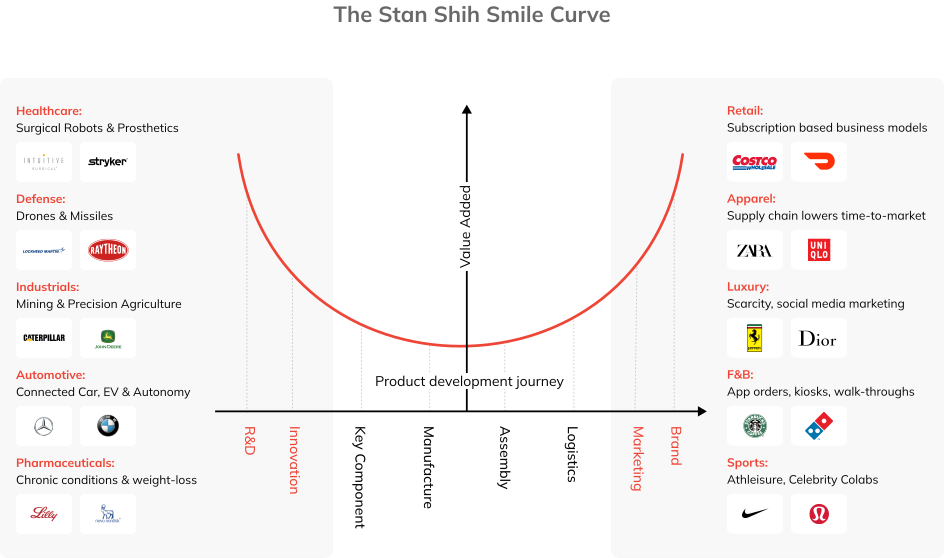
The Stan Shih Smile Curve illustrates that the greatest opportunity to add value lies at the beginning ‘Technical Phase’ (R&D/Innovation) and the ending ‘Sales Phase’ (Marketing/Brand) of a product’s development journey.

Both technical innovation (in areas like engineering, pharmaceuticals, etc.) and sales innovation (such as new sales models or generating ‘brand heat’) have created phenomenal businesses-often monopolies-with superlative margins and durable competitive moats.

International Dominance

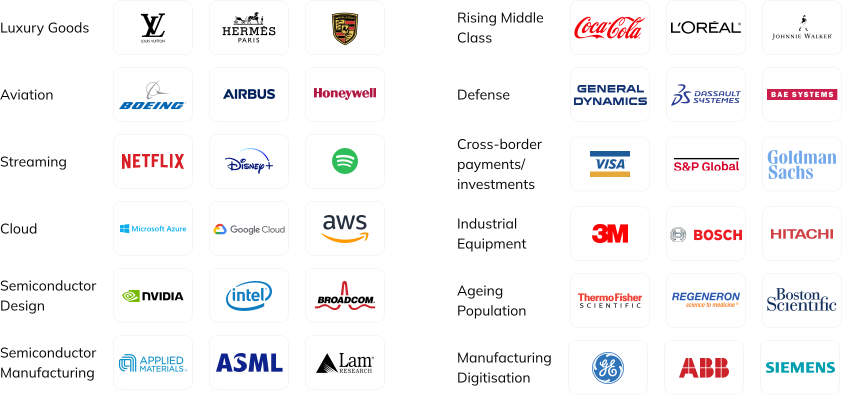
A small number of firms own the high-growth Industries of the Future, world-wide.

Often the products they supply are essentials, and have little/no local competition.

Globally Dominant Businesses

India has almost no listed businesses in any of these industries of the future. Exposure can only be taken internationally.
Globally Dominant Businesses

Globally Dominant Businesses

India has almost no listed businesses in any of these industries of the future. Exposure can only be taken internationally.

  • Luxury Goods
    • Luxury Goods
    • Luxury Goods
    • Luxury Goods
  • Rising Middle Class
    • Rising Middle Class
    • Rising Middle Class
    • Rising Middle Class
  • Aviation
    • Aviation
    • Aviation
    • Aviation
  • Defense
    • Defense
    • Defense
    • Defense
  • Streaming
    • Luxury Goods
    • Luxury Goods
    • Luxury Goods
  • Cross-border payments/ investments
    • Cross-border payments/ investments
    • Cross-border payments/ investments
    • Cross-border payments/ investments
  • Cloud
    • Cloud
    • Cloud
    • Cloud
  • Industrial Equipment
    • Industrial Equipment
    • Industrial Equipment
    • Industrial Equipment
  • Semiconductor Design
    • Semiconductor Design
    • Semiconductor Design
    • Semiconductor Design
  • Ageing Population
    • Ageing Population
    • Ageing Population
    • Ageing Population
  • Semiconductor Manufacturing
    • Semiconductor Manufacturing
    • Semiconductor Manufacturing
    • Semiconductor Manufacturing
  • Manufacturing Digitisation

    • Manufacturing Digitisation

    • Manufacturing Digitisation

    • Manufacturing Digitisation

These sectors are typically dominated by two to three global players, creating a powerful oligopoly that gives these businesses a world-wide stranglehold on these high-growth sectors of the future.

These businesses are absolutely indispensable to modern life in any country. Across the world, their consumer brands and capital equipment play a major role in ‘the modern human experience’ and national development respectively. Their profit growth reflects their criticality to the world.

By investing in America,

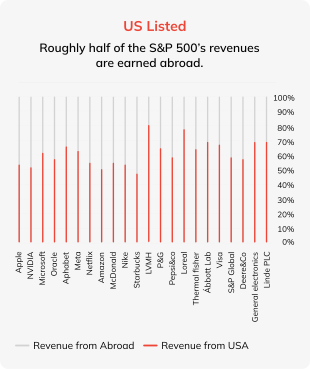
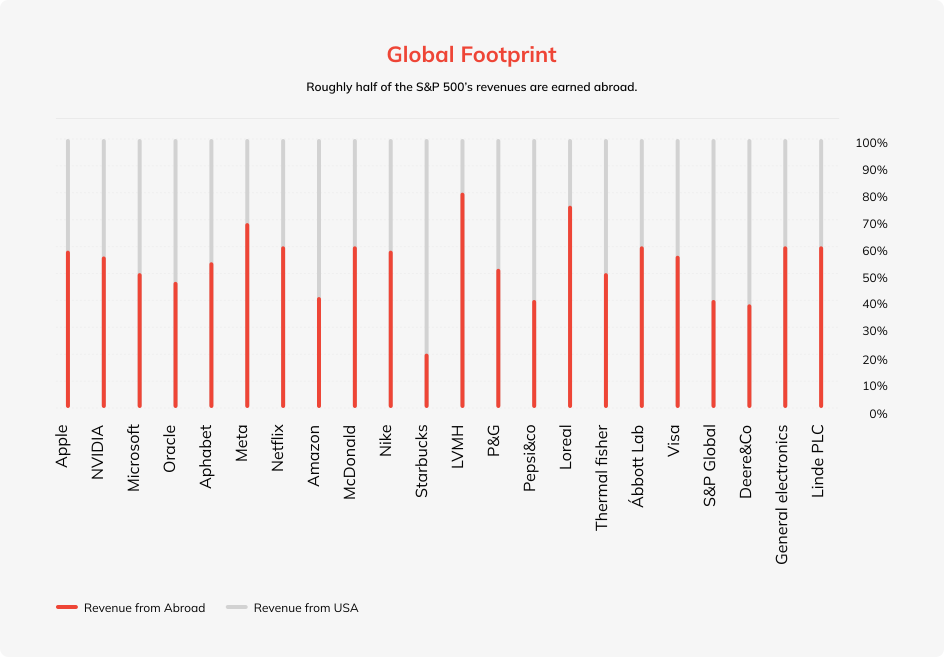
We are not betting on the US economy, but the world economy.

G20 businesses view their Total Addressable Market (TAM) not as limited to their domestic economies, but as the entire global economy.

Their international presence positions them to capture high growth in emerging markets by outcompeting local players. Geographic diversification also enhances their resilience against downturns in individual countries.

Every major country has its own competitive advantages and national champions.

E.g. US Tech, German Capital Equipment, Korean Consumer Electronics, Japanese Automobiles, Taiwanese Chips, Indian IT services etc.)

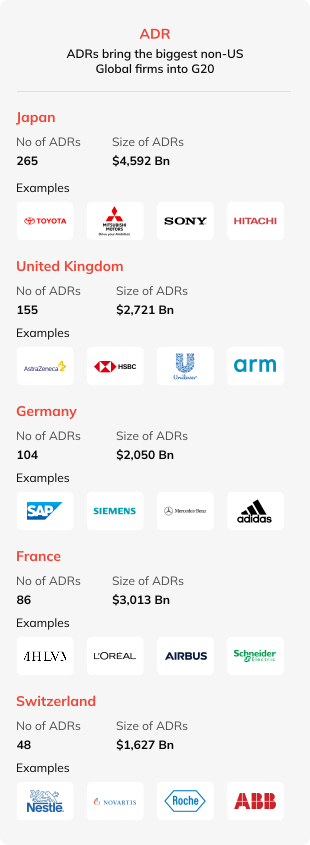
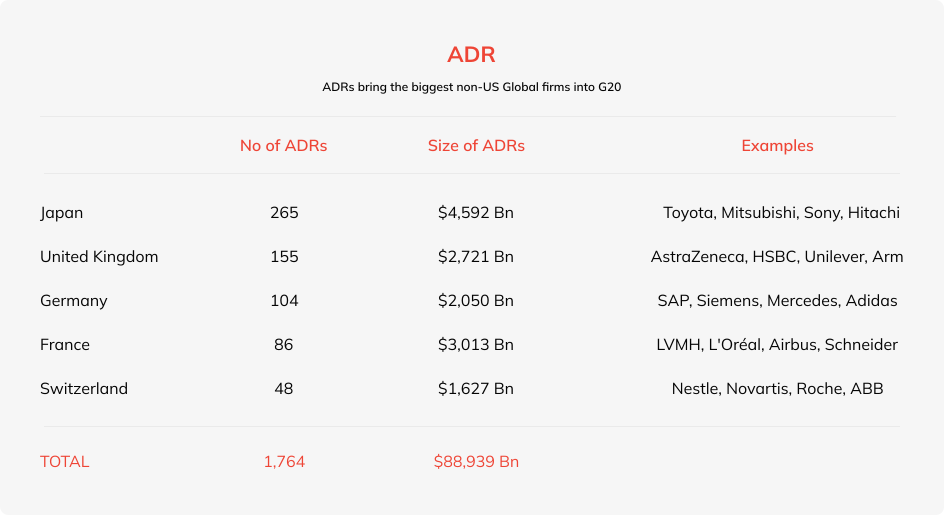
Every major country has nurtured global champions that are listed in the US markets as ADRs

Disclaimer: All trademarks, logos, and brand names used on this website are the property of their respective owners. These trademarks are used for identification and informational purposes only and do not imply any endorsement, affiliation, or sponsorship by the trademark holders.

1

The Power of Invention

Creates new markets;
Grows human productivity

Investing in Innovation

Start with the evident: Big Tech

The information revolution has been one of the fastest & biggest value creators the world has ever seen.

The big grow bigger because the biggest tech companies have captured the lion’s share of tech’s value creation due to: Scale of resources, M&A of smaller competitors, product bundling, access to customer data, access to compute recourses, ability to recruit top engineering talent etc..

Beyond Big Tech, there is enormous invention in Growth Tech

There is enormous potential for a plethora of large high-growth tech firms to drive the next leg of technological growth

Major technological transformations occur only once or twice in an investor’s life. Riding the wave of value creation when these disruptive changes occur is a big part of what the G20 portfolio is about.

There is also tremendous innovation in non-tech industries

In industries beyond tech, innovation- both technical & non-technical innovation- has generated enormous returns for shareholders.

The Stan Shih Smile Curve

The Stan Shih Smile curve shows how the opportunity to add value is greatest in the beginning ‘Technical Phase’ (R&D/Innovation) and at the ending ‘Sales Phase’ (Marketing/Brand) of a product’s development journey.

Both Technical Innovation (such as Engineering, pharmaceuticals etc.) and Sales Innovation (such as new sales models, generating ‘Brand Heat’ etc.) have created phenomenal businesses- oftentimes monopolies- with superlative margins & durable competitive moats.

2

International Dominance

Constantly expands TAM;
Free Trade efficiencies

Investing in Globalisation

A small number of firms own the high-growth industries of the future, world-wide.

Often the products they supply are essentials, and have little/no local competition.

Globally Dominant Businesses

India has almost no listed businesses in any of these Industries of the Future. Exposure can only be taken internationally.

  • Luxury Goods
    • Luxury Goods
    • Luxury Goods
    • Luxury Goods
  • Rising Middle Class
    • Rising Middle Class
    • Rising Middle Class
    • Rising Middle Class
  • Aviation
    • Aviation
    • Aviation
    • Aviation
  • Defense
    • Defense
    • Defense
    • Defense
  • Streaming
    • Luxury Goods
    • Luxury Goods
    • Luxury Goods
  • Cross-border payments/ investments
    • Cross-border payments/ investments
    • Cross-border payments/ investments
    • Cross-border payments/ investments
  • Cloud
    • Cloud
    • Cloud
    • Cloud
  • Industrial Equipment
    • Industrial Equipment
    • Industrial Equipment
    • Industrial Equipment
  • Semiconductor Design
    • Semiconductor Design
    • Semiconductor Design
    • Semiconductor Design
  • Ageing Population
    • Ageing Population
    • Ageing Population
    • Ageing Population
  • Semiconductor Manufacturing
    • Semiconductor Manufacturing
    • Semiconductor Manufacturing
    • Semiconductor Manufacturing
  • Manufacturing Digitisation

    • Manufacturing Digitisation

    • Manufacturing Digitisation

    • Manufacturing Digitisation

These sectors are typically dominated by 2-3 global players, creating a powerful oligopoly that gives these businesses a world-wide stranglehold on these high-growth sectors of the future.

These businesses are absolutely indispensable to modern life in any country. Across the world, their consumer brands and capital equipment play a major role in ‘the modern human experience’ and national development respectively. Their profit growth reflects their criticality to the world.

By investing in America,

We are not betting on the US economy, but the world economy.

G20 businesses see their Total Addressable Market (TAM), not as their domestic economies, but as the world economy.

The international nature of their businesses positions them to capture some of Emerging Markets’ high growth by eating the lunch of local competitors. Geographic diversification also makes them resilient to downturns in individual countries.

Every major country has a competitive advantage & national champion

E.g. US Tech, German Capital Equipment, Korean Consumer Electronics, Japanese Automobiles, Taiwanese Chips, Indian IT services etc.)

Since G20 is not restricted by national borders, we intend to assemble the portfolio by cherry-picking the best business from each country’s core competency.

ADRs allow G20 to do this with simplicity, tax-efficiency and liquidity.

The G20 Investment Universe

The G20 Investment UniverseThe G20 Investment Universe
1

Large-cap Filter

  • 1. World's strongest & most stable businesses
  • 2. Gold standard shareholder services- no information asymmetry
  • 3. Deep sell side coverage support- Low Mosaic theory
2

Global Filter

  • Exclude firms earning more than 75% of their revenue from the US – e.g., banks, insurance, utilities, real estate, and telecom.
3

Commodity Filter

  • Since commodities trade at global prices, there is no benefit to investing in, for example, a German over an Indian steel maker.
4

Domain Filter

  • We exclude firms that require specialised country or domain knowledge to evaluate
  • 1. Sectors such as e.g., Biotechnology
  • 2. EM Economies
5

Investment Universe

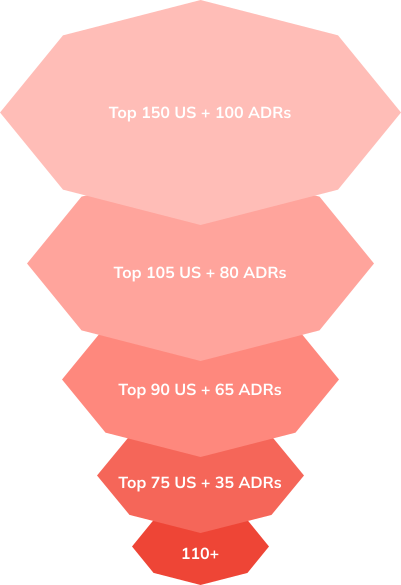
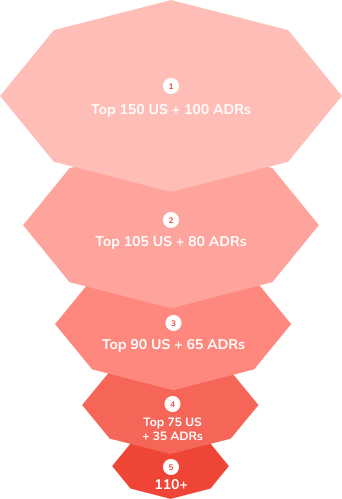
  • Top 75 US stocks + 35 ADRs + Compelling opportunities outside this universe
  • Consumer Discretionary

    Consumer Discretionary

    24

  • Industrials

    Industrials

    24

  • Information Technology
    Information Technology
    17

  • Consumer Staples

    Consumer Staples

    16

  • Financials

    Financials

    14

  • Healthcare

    Healthcare

    11

  • Communication Services

    Communication Services

    04

  • Materials

    Materials

    03

AIF Details

  • Investment Structure Cat 3 AIF – Open ended domiciled in GIFT City, IFSC
  • Minimum Investment $150,000 ($60,000 for Accredited Investors)
  • Distributor Fees Option 1 2% p.a. Management Fees
  • Distributor Fees Option 2 1.5% p.a. Mgt. Fees and 10% performance fees over a 6% p.a. Hurdle Rate (Pre-tax) charged March end annually.
  • Fund Custodian Kotak Mahindra Bank, IFSC
  • Fund Legal IC Universal Legal
  • Fund Tax Advisor PWC, GIFT IFSC
  • Tax at the fund level STCG < 2 years at MMR and LTCG > 2 years at 12.5% plus applicable charges. No tax at the hands of the investor.
  • Lock – In 2 Years [> 2 years no lock-in.]
  • Exit Load Nil.

For direct/RIA please contact ir@unifiinvestment.com.

Documents

G20 Fund - Factsheets

2026
2025

Quarterly Newsletters

2025

Complaints Data

Complaint Handling & Grievance Redressal

At Unifi Investment Management LLP, we are committed to resolve the complaints in fair and transparent manner, in line with the “Complaint Handling and Grievance Redressal by Regulated Entities in the IFSC” dated December 02, 2024.

How to File a Complaint

Complainant can submit complaints via:

Email: grievance@unifiinvestment.com

In-person: Unit 509, 5th Floor, Hiranandani Signature, Block 13B, Road 1C, Zone 1, GIFT SEZ, GIFT City, Gandhinagar, Gujarat – 382 355.

Complaint Redressal Officer (CRO)

Name: Rima Patel
Email: grievance@unifiinvestment.com
Phone: +91 9727822388

Acknowledgment: Within 3 working days
Resolution: Within 30 working days

Appeals & Escalation

If unsatisfied with the CRO’s resolution, escalate the complaint to CRAO preferably within 21 days of CRO’s decision:

Complaint Redressal Appellate Officer (CRAO)

Name: Jay Kansara
Email: jay@unifiinvestment.com
Phone: +91 9673031886

Resolution Timeline: Within 30 working days

If still unresolved, escalate to IFSCA at grievance-redressal@ifsca.gov.in

Disclosure document

To view the disclosure document, click here.

FAQs

The G20 fund is a GARP  investor in 15-25 large-cap Global US-listed businesses that drive the world in pioneering innovation and international expansionism. Such businesses are not listed in India, making them unique and a good complement to Indian equities. This offers investors a chance to tap into global growth while diversifying across market cycles.

The fund is an open-ended Category III AIF, domiciled in GIFT City (IFSC) and regulated by the IFSCA.

The fund has a monthly dealing/valuation day. Purchases or redemptions are made once a month on the last working day.

At the Fund level, for trades held for less than 2 years, the gains are taxed at the Maximum Marginal Rate (MMR). For trades held for more than 2 years (Considered long-term), the tax rate is 12.5% plus applicable charges.

For investors, the returns are post-tax. Hence, no additional tax needs to be paid on them.

No. The Fund is a non-resident of the US and hence does not pay any capital gain tax in the US on the sale of the equities. As a result, capital gains tax is paid only in India, as explained in Q.4.

Dividends declared by US-listed companies are subject to a 25% withholding tax in the US. Under the Double Taxation Avoidance Agreement (DTAA) between India and the US, the fund pays only the difference (if any) between this 25% and the applicable tax rate in India.

The fund aims to seek quality capital from like-minded, long-term investors. Unifi will work closely with distributors and investors to set a clear expectation of a minimum investment horizon of three to five years. Although the fund is open-ended, we intend to discourage short-term participation. To ensure alignment, each investment is subject to a two-year hard lock-in period from the date of investment. The 2 years is applicable for additional purchases as well.

There is no exit load, apart from the two-year lock-in period.

Any resident Indian – Individual or Non-Individual – can invest in this fund. Resident individuals invest through the Liberalised Remittance Scheme (LRS), while non-individuals such as Registered Partnerships, LLPs, Private and Public Limited companies can use the Overseas Portfolio Investment (OPI) route.

NRIs are advised not to invest in this fund due to tax inefficiencies. Typically, NRIs are not subject to capital gains tax in India on direct investments in foreign equities. However, investing through this fund would result in indirect exposure to post-tax returns at the fund level, which may reduce overall tax efficiency for NRI investors.

The minimum investment is USD 150,000, with additional investments in multiples of USD 10,000.

For Accredited Investors (AIs) who meet the eligibility criteria defined by the IFSCA, the minimum investment is USD 60,000, with top-ups in multiples of USD 5,000. If you would like to invest less than USD 60K as AI, reach out to our relationship manager.

Criteria for AI: Click here

Under the Liberalised Remittance Scheme (LRS), a resident Indian individual can remit up to USD 250,000 per financial year. While initiating the remittance, the investor should select the below purpose code

Purpose

Group Name

Purpose Code

Description

Capital Account

P0001

Repatriation of Indian investment abroad in equity capital.

As per current regulations, Tax Collected at Source (TCS) is levied at 20% on remittances exceeding INR 1,000,000 in a financial year.

For example, if an investor remits USD 100,000 at an exchange rate of INR 85/USD, the total remittance amounts to INR 8,500,000. TCS is applicable on the amount exceeding INR 1,000,000—that is, on INR 7,500,000. The TCS payable would be INR 1,500,000 (20% of INR 7,500,000). This amount is debited separately from the investor’s bank account after the remittance is processed.

Investors can also offset this TCS against the TDS payment or Advance tax as per the recent guidelines. We suggest to take the advise of your CA or tax consultants for such matters.

Yes, the Funds held in the foreign bank account on account of sale of any foreign investments can be transferred to the Unifi G20 Fund bank account. Such transfers don’t count under your current year LRS limit.

However, you cannot transfer the shares held outside to the Unifi G20 Fund directly.

No. For funds domiciled in GIFT City (IFSC), unlisted Indian entities do not require prior RBI approval to invest. GIFT City remains the only overseas jurisdiction where such entities are permitted to make Overseas Portfolio Investments (OPI) into investment funds, as per Schedule V of the OI Directions under FEMA.

Investors can remit funds in USD through their authorised bankers under the OPI route. For further assistance, they may contact our Investor Relations team.

No. There is no risk of US estate tax upon the demise of an individual investor, as the Fund—not the investor—legally owns the underlying US equities.

Investors hold units in the Fund, not direct ownership of the US assets, and have a beneficial interest only to the extent of their unit holdings.

In contrast, individuals holding US assets directly exceeding USD 60,000 may be subject to US estate tax under current regulations.

This investment should be disclosed under Schedule FA (Foreign Assets) of your ITR. Schedule FA requires the reporting of foreign assets you hold or have any beneficial interest during the relevant calendar year.

For investors in the G20 Portfolio, only the Fund needs to be reported—not the underlying individual stocks or securities. This significantly simplifies the foreign asset disclosure requirements for ITR

The table below summarises the relevant section within Schedule FA for this disclosure.

SectionDescriptionExamples
A3Foreign  Equity C Debt InterestMutual funds, stocks, bonds, and other financial instruments held outside your country of residence (includes beneficial ownership).

In 2008, the RBI imposed an industry-wide cap of $7 billion on international investments by Indian mutual funds. This limit was fully utilised by February 2022, forcing mutual funds to suspend any further investments abroad. Since then, mutual funds have not been able to issue fresh, non-dilutive units to investors since then.

As a result, investors seeking meaningful international allocation through mutual funds are currently limited to just two options:

 Defining limitation
Indian MFs / Feeder Funds
  1. Dilution: Due to the $7B RBI cap, new units can only be issued by diluting the fund’s international exposure. As a result, the already limited international exposure of these funds will continue to shrink over time.
  2. Small International Exposure: Past dilution has left these funds with minimal international exposure (typically 10%-20%), forcing investors to hold 80%-90% in Indian stocks they may not want.
  3. Lack of Dedicated Research: Many funds rely on borrowed conviction, as they may not have an in-house, dedicated global research team due to their small international holdings.
  4. Limited Choices: There are very few options available for investors looking to invest in international equities.
  5. High Fees: In case of Feeders, Investors must pay fees on both the India Feeder C the foreign Master fund, resulting in high overall fees- nearing 3% in some cases.
ETFs
  1. Risk of Loss: Since the $7B RBI cap has been reached, new units cannot be created. As a result, new investors must purchase units through Indian stock exchanges, causing the price of these ETFs to trade at a premium to the value of the underlying units, which at some point was as high as ~18%. This exposes investors to a significant loss if the investment limits are ever raised or when market witness correction, as the traded price may converge to the underlying value of the units
  2. Overreliance on Passive Index Funds: The majority feed into passive index funds, which typically hold a large basket of low-conviction stocks.

The G20 Portfolio has been carefully designed in accordance with the regulatory framework that caters specifically to High Net worth Individuals (HNIs) who are committed to building international portfolios. Leveraging the GIFT City IFSC framework, the Fund is empowered to invest actively in a concentrated portfolio of 100% international equities, thus overcoming the limitations associated with traditional Mutual Funds.

In addition to its regulatory advantages, the G20 Portfolio has distinct competitive advantages over MFs for the following reasons, irrespective of taxes at the fund level:

  1. In-House Expertise: Over the past three years, Unifi has built a dedicated global equities research team from the ground up, developing the expertise to support international portfolio research entirely in-house. Additionally, Unifi has formed partnerships with leading global sell-side advisors for enhanced research
  2. Proven GARP Investment Philosophy: Unifi’s time-tested Growth at a Reasonable Price (GARP) philosophy is universally applicable. This approach, grounded in the principles of value investing, provides a margin of safety and serves as a strong driver of investment
  3. Focus on Structural Growth: The Fund’s investment universe funnel follows a focused strategy that exposes G20 to the dual forces of innovation and international expansion, positioning the portfolio to capitalize on deeply structural This approach sets the stage for long-term, low-turnover investing, which ultimately should generate tax- efficient returns.
  4. Concentration on Top Global Businesses: The G20 Portfolio focuses on selecting the world’s 20 most powerful businesses. This concentration strategy enables the portfolio to deliver returns that are significantly differentiated from the benchmark.

The G20 Portfolio is benchmarked against the MSCI World Large-Cap Index, which best represents the Fund’s investment universe. It will be investing in businesses that are leaders across sectors in the developed markets.

Yes and no.

The G20 Portfolio invests in some of the world’s largest and most prolific businesses, with a majority (approximately 68%) headquartered in the US. However, the Fund also invests in non-US Developed Market businesses (primarily from Europe and Japan) through US-listed ADRs (American Depository Receipts).

ADRs are shares of foreign companies that trade on US exchanges. Investing in ADRs brings the best of the world into the G20 fund while sparing the fund’s investors from the regulatory and tax compliance that would otherwise come from investing in each foreign country.

In terms of the number of companies, The G20 Portfolio’s investment universe has a ~16% and

~28% overlap with the S&P 500 and Nasdaq 100 respectively.

The majority of the global businesses that are in the G20 investment universe have ADRs that are listed in the USA, negating the need for the Fund to trade on any foreign exchanges.

The fund intends to buy or sell only on US exchanges for several reasons:

  1. For ease of operation
  2. To avoid cross-currency risk
  3. To avoid multi-jurisdiction Tax C regulatory
  4. To benefit from the world’s most stable and highly regulated jurisdiction.
Scroll to Top